What Is MAIC? A High-Performance Particle Coating Technology
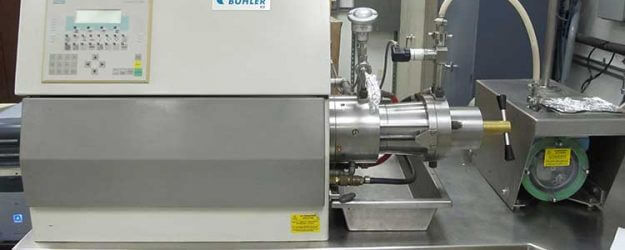
MAIC (pronounced “mace”) is a patented, advanced coating technology designed to permanently attach smaller particles to larger particles—or to uniformly apply micro-quantities of liquids onto solid materials. Unlike traditional coating methods, the MAIC system uses a magnetically driven pounding process: small magnetic elements are fluidized within an oscillating magnetic field, rapidly forcing coating materials onto the surface of core particles with exceptional precision and durability.
How the MAIC Process Works
Inside the MAIC chamber, core and coating materials continuously flow through magnet beds operating at 1–270 kg/hour. As the magnets oscillate, they:
· Embed fine particles onto larger core particles
· Evenly distribute small liquid doses (such as organosilanes) across particle surfaces
· Create robust, long-lasting adhesion that resists vibration, transport, and dispersion
This process has been successfully used with food powders, pigments, metal oxides, polymers, glass materials, organic and inorganic powders, and more.
Why MAIC Outperforms Traditional Coating Methods
Conventional methods, for example, adding fumed silica to improve powder flow—often fail because the coating particles are not permanently bonded and easily detach. MAIC solves this by creating a stable composite particle with two key advantages:
1. Dramatically Reduced Additive Requirements
MAIC can lower the amount of silica or other coating materials needed by up to an order of magnitude, thanks to precise distribution and permanent adhesion.
2. Long-Term Stability and Non-Separation
After treatment:
· Coating particles remain firmly attached during handling, shaking, and transportation
· Blends resist separation, even under vibration
· Composite particles stay intact when dispersed into liquids
The result is superior flowability, stability, and performance compared to traditionally coated powders.
Material Requirements for Optimal MAIC Performance
For MAIC to produce consistent coatings, the particle size ratio is critical:
· The core particle must be at least 10× larger than the coating particle
· Materials with higher density process more quickly
· Stickier or tackier materials may move more slowly through the system
These parameters help ensure reliable, uniform, and high-quality coatings across a wide range of material types.
Key Benefits of the MAIC Technology
· Permanent particle adhesion
· Even distribution of micro-dosed coatings
· Reduced coating material usage
· Improved powder flowability
· Non-separating, stable blends
· High-throughput continuous processing