Most people have never heard of fluid bed drying, yet it’s one of the most important technologies behind the powders used in food, personal care, industrial materials, and countless specialty applications. For companies that need consistent, gentle, and efficient drying, fluid bed technology is often the difference between a workable product and one that fails.
At AVEKA, fluid bed drying is one of our core processing strengths. Here’s a quick look at how it works, why it’s so effective, and how we recently used it to help a beauty‑care customer bring a new product to life.
What is fluid bed drying, and how does it work?
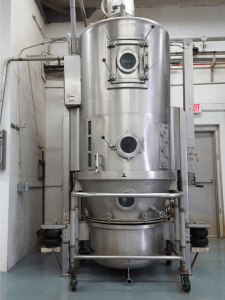
Fluid bed drying starts with a wet material—often a “wet cake” that has already been filtered to remove most of the liquid. The material is placed into a stainless‑steel bowl, sealed into the dryer, and exposed to heated air flowing upward through a perforated plate.
As the air passes through, it lifts and suspends the particles, creating a “fluidized” state. The material behaves almost like a liquid, allowing hot air to surround each particle evenly. This results in:
-
-
Faster drying
-
More uniform moisture removal
-
Less particle damage
-
Why Choose Fluid Bed Drying?
Fluid bed drying is ideal for:
-
-
Heat‑sensitive materials
-
Particles larger than ~50 microns
-
Products that require gentle handling
-
Applications where uniformity is critical
-
Compared to other drying methods, fluid bed drying offers:
-
-
Lower attrition — particles stay intact
-
More consistent moisture levels
-
Flexible temperature control (ambient to ~120°C)
-
Efficient processing for a wide range of industries
-
You’ll find fluid bed dryers used in:
A Real‑World Example: Drying a Sensitive Personal Care Product
A beauty‑care customer approached AVEKA with a challenge: they needed to dry a blend of fragile, heat‑sensitive ingredients while meeting strict FDA and microbial‑control requirements.
The challenges:
-
-
Heat‑sensitive raw materials
-
Fragile particle structures
-
Tight microbial specifications
-
Complex packaging needs
-
Why fluid bed drying was the solution:
The gentle, uniform nature of fluidization allowed us to dry the material without damaging the particles or compromising quality.
How AVEKA Delivered
Our team began with small‑batch testing to dial in the ideal drying conditions. Once the process met both AVEKA’s and the customer’s quality standards, we scaled up production in our fluid bed suite in Fredericksburg, Iowa.
The results:
-
-
Moisture reduced from ~60% to 7%
-
Consistent, fine, free‑flowing powder
-
Custom blending of starch‑based materials for pigmentation
-
Continuous quality monitoring
-
Safe, efficient discharge using our pneumatic Vacuum Max system
-
Ready‑for‑market packaging support
-
The outcome: a cost‑effective, high‑output process, a satisfied customer, and a strong foundation for future product development.
Need Fluid Bed Drying? Let’s Talk.
Whether you’re working with heat‑sensitive materials, fragile particles, or a formulation that requires precise moisture control, AVEKA can help. Our team combines deep technical expertise with flexible processing capabilities to take your product from concept to commercial scale.
Let’s find your solution. Reach out for a commitment‑free feasibility assessment.
Processing Services
Industries